

Organized chaos, an interview with Chaos Canyon

By this point if you haven't heard of Chaos Canyon, you're new or you've been asleep for the last 5 years. The tracks of Chaos Canyon are some of the most detailed and entertaining with jumps, drifts, and wonderful commentary to boot. And after a good 5 years of racing, a new track is about to debut…Gasoline Gorge!
I recently talked to the man behind the chaos curtain, Warwick Rule, about the new track and how things work over at Chaos Canyon. He was gracious enough to share some stories about the past, the present, and the future.
UPDATE: Watch the first race at Gasoline Gorge!!
- Watch and subscribe to the Chaos Canyon channel on YouTube
- Visit the official website for merch and more
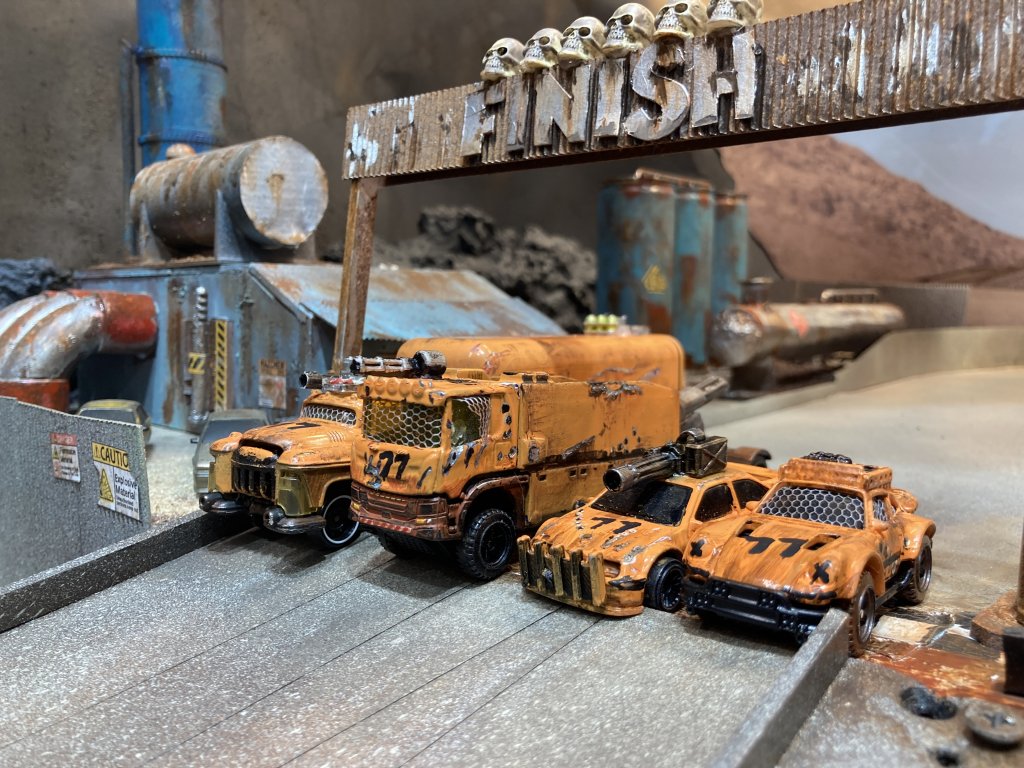
Interview with Warwick Rule, Chaos Canyon
Redline Derby: It's been a while since we've talked, so tell the community who you are, where you are, and what's your favorite breakfast cereal?
Chaos Canyon: I’m Warwick and I live in The Mighty Waikato Region of New Zealand. Favourite cereal is Nutrigrain.
RLD: You're otherwise known to the diecast racing world as Chaos Canyon and have been running races since early 2020. What first inspired you to build a diecast track and jump into this wonderful niche of a hobby?
CC: Like a large number of people here, it was seeing 3DBotMaker’s rally track when it first launched at the start of 2020 that got me playing with my Hot Wheels again. I only got onto it because there was an article in the motoring section about the new track in an online news site in New Zealand and I watched the first one and was hooked.
I immediately dragged out my few old Hot Wheels and bought some track pieces and set up a couple of very silly little tracks and loved it. I grew up with a couple of old continuous track rolls that we’d hook to a door handle and put some jumps and loops into and I went straight back to being a kid.
Not long after we went into a national lockdown and while I still had to work remotely, I was able to focus on the track after hours and built it out of anything I could find around the house. If you watch that first series in my videos, it’s dark (only had three lights that didn’t strobe) and the track was so rough but I absolutely loved it.
I tend to only keep a track for 1-2 years because I start to get bored with it and want something different, so I'm not sure how long the new track will last.
Welcome to Gasoline Gorge
RLD: You just announced your latest track to the world, Gasoline Gorge! It's an awesome, elaborate build with a wonderful post-apocalyptic theme. I'm not sure anyone needs a good reason to go with a Mad Max gimmick, but what led you to that choice compared to others? How long had you been dreaming up the track before you started building?
CC: This was actually the track I wanted to build when I first designed a proper track, including the seesaw bridge that this new track has. So it’s been about 5 years in the making and regular viewers will know I’ve always enjoyed that worn out, apocalyptic style look, which is why the Outlaws was always beat-up old school vehicles.
www.youtube.com/watch?v=ozbji-6kQEE
RLD: Gasoline Gorge has a lot of moving parts with technology that reacts to the live racing. Which part of all that took the most trial & error to get to a point where you were happy with it? What challenged you in a way you didn't quite expect?
CC: Yeah, this is definitely the most elaborate to set up. Thankfully I’ve used Arduinos for a few tracks now, so decided to use those as the main controllers, but there were definitely challenges.
Normally I had powered servos via battery packs, but that’s a real pain as you either need a bunch of separate switches to isolate the packs so they don’t go flat, or you have to pop the batteries out or just replace them a lot. So this time round I decided to try powering them via the wall sockets. This took a bit of messing around but finally got it to work and it makes it a lot easier.
I also had to have the traps run separately to the start gate, cause they are only for Death Races, so there are actually three Arduinos set up around the track. I may have been able to do it with less, but I’m still very much a beginner with programming etc., so it was easier for me to manage and troubleshoot doing it that way.
The swinging weight and the rock dumper both use a light dependent resistor (like a lot of drag tracks use) to act as the trigger, which means a car has to pass over the exact spot which keeps it a bit more random rather than guaranteeing they’ll go off each time.
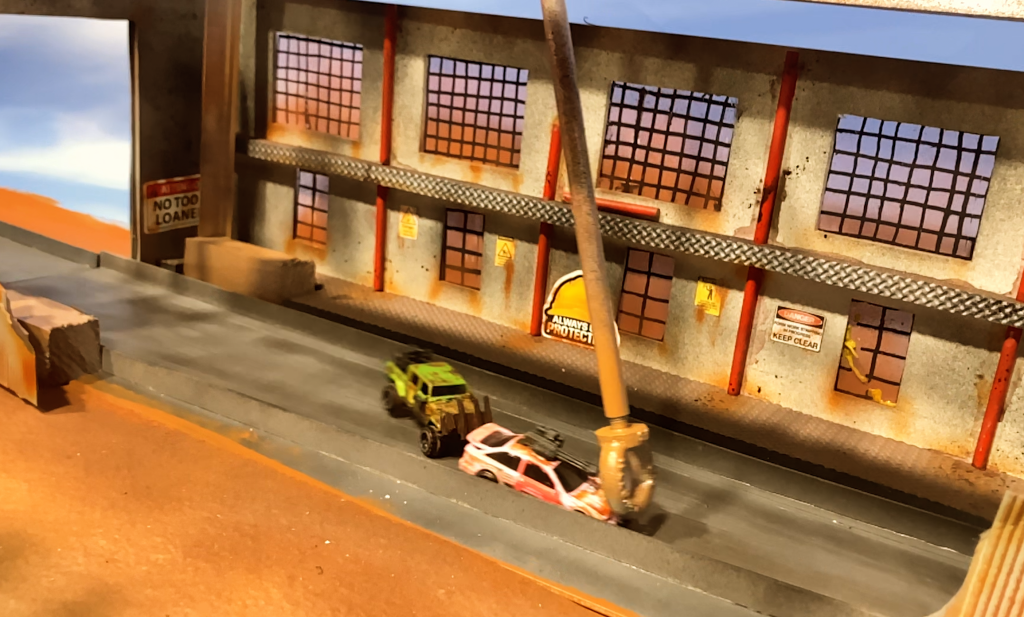
There are also some LDR sensors in the final straight, but as there is a raised gate at the finish where the Marauders (other cars) are waiting to be released, I had to add a break beam sensor as well to ensure the gate is dropped so cars can finish if they make it that far.
Getting a setup for the Crash Racer Marauders was the most challenging, as they were running out of power when I had them just waiting behind the gate burning rubber. There was an easy fix in the end, where they now have their rear end hanging on the top of the gate, so the rear wheels can free spin with no drag until the gate drops. It’s left them with more power when they are released now.
The most complicated part of the whole thing was actually getting the seesaw system to work correctly. I made one lane and tested it all and got that working, then made another three and realised I hadn’t allowed enough gap between them and they were binding, so remade them again.
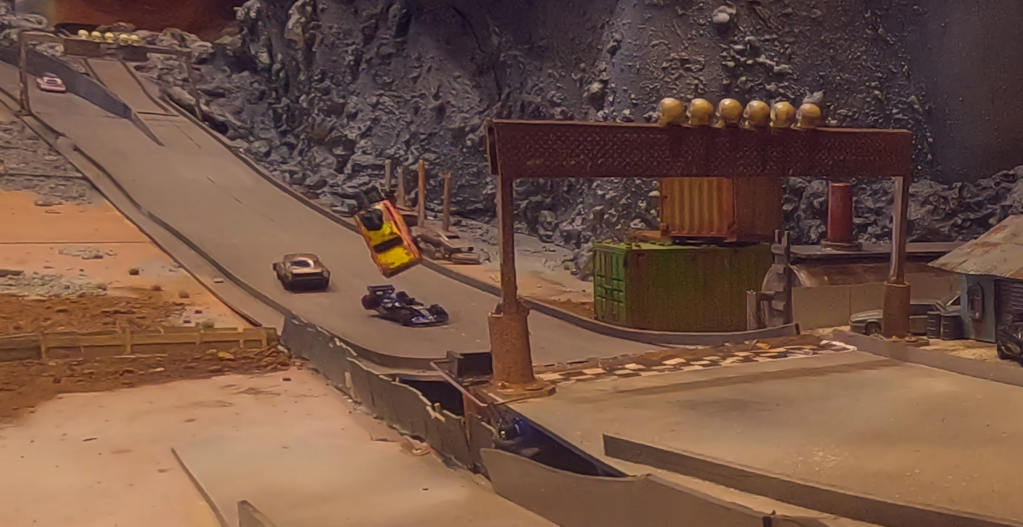
What you see there is version 8 or 9, I believe, including all the single lane testing. I wanted it to have a bigger drop but the fast cars were going so fast they’d fly off the end before it had dropped fully and caused too many crashes.
Cars can still crash with the way it is now, but it helps split the vehicles up a bit before the 2-into-1 lanes, which was the main need for it.
RLD: Likewise, what feature was surprisingly easy to create but looks far more complicated?
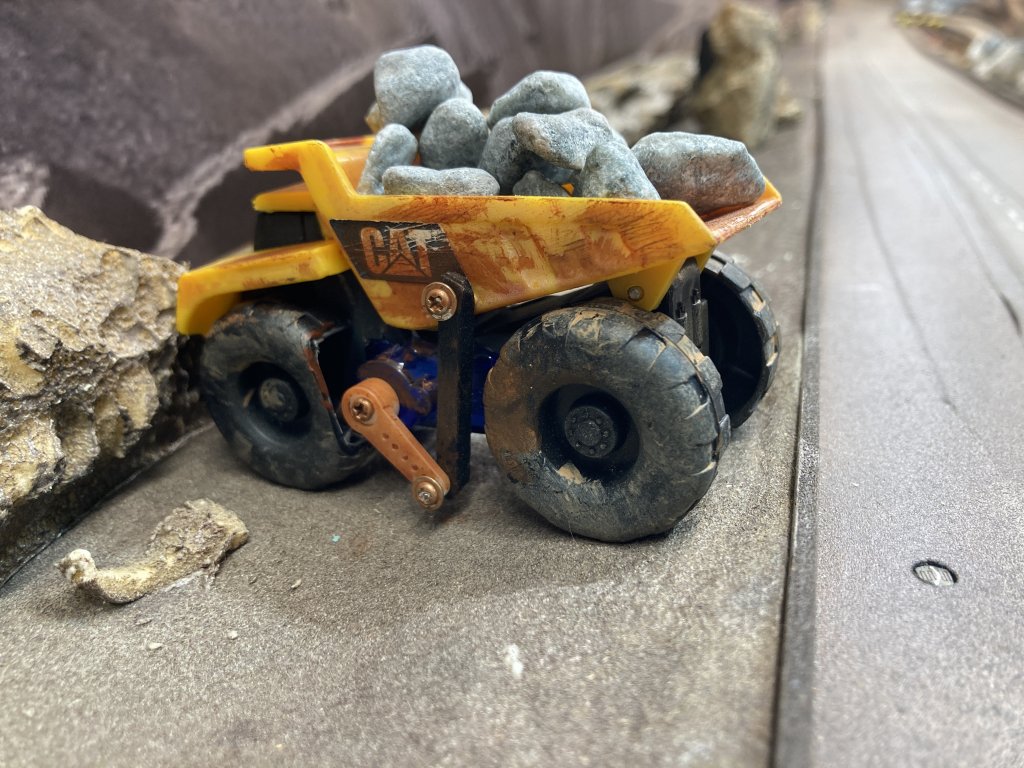
CC: The dump truck. Originally there were going to be spikes that popped up out of the track when you drove over a sensor, but that was going to require cutting holes in the track and having parts vehicles would drive over, so they needed to fit really well.
My 3D printer was out of commission for about 2 months, so I was sitting in my shed thinking about what to do and had this random idea about something tipping rocks onto the track.
It’s just a servo literally glued to the bottom of the dump truck with a short arm screwed directly into the side of the tip tray. It worked on the first attempt in testing and I was hooked.
The cool thing is I can put anything in the tray, different rocks, one large rock, a whole bunch of bogans … anything really ????
Building and learning
RLD: I know I always have big plans for things but they often get whittled down because of reasons... yet the final product ends up better. Were there any features you had planned but ultimately cut, and looking back, do you think the track ended up better because of it?
CC: I pretty much implemented everything I wanted, although originally the track had a jump at the start instead of the seesaw.
I love jumps but they can be far too unpredictable for racing, especially how I wanted it to work originally. I made the jump over about 4 times before going to the seesaw idea.
Very happy how that turned out and while the cars can crash, it gives a much better start for most cars.
RLD: After building for several years, I'm sure some of the build process has become second nature to you. But what new skills did you learn (or improve) while building Gasoline Gorge?
CC: The electronics side of things has definitely expanded. As I mentioned, I’m very beginner level with programming but each track seems to have added more and different aspects to the previous.
The drag track was the first time I’d used LDRs and that was good because they became important on this track, for the trap sensors. Learning how to troubleshoot them on the track has been vital.
If you aren’t familiar with them, you need to know what their nominal reading is in the lighting where they will be on the track and what a "dark" reading is, for when something drives over it.
You can sort these on your bench or in my case on my computer in the house, but put them on the track in the shed with different lighting and they can be totally different.
Thankfully I have a laptop as well, so was able to set up at the track and check/adjust all the sensor settings, as they all needed tweaking. My troubleshooting of electronics has also improved doing these tracks.
RLD: The racing community is always impressed with the amount of detail put into your tracks... it's easy to see the passion for the work, but what's your favorite small track detail that viewers may not even notice?
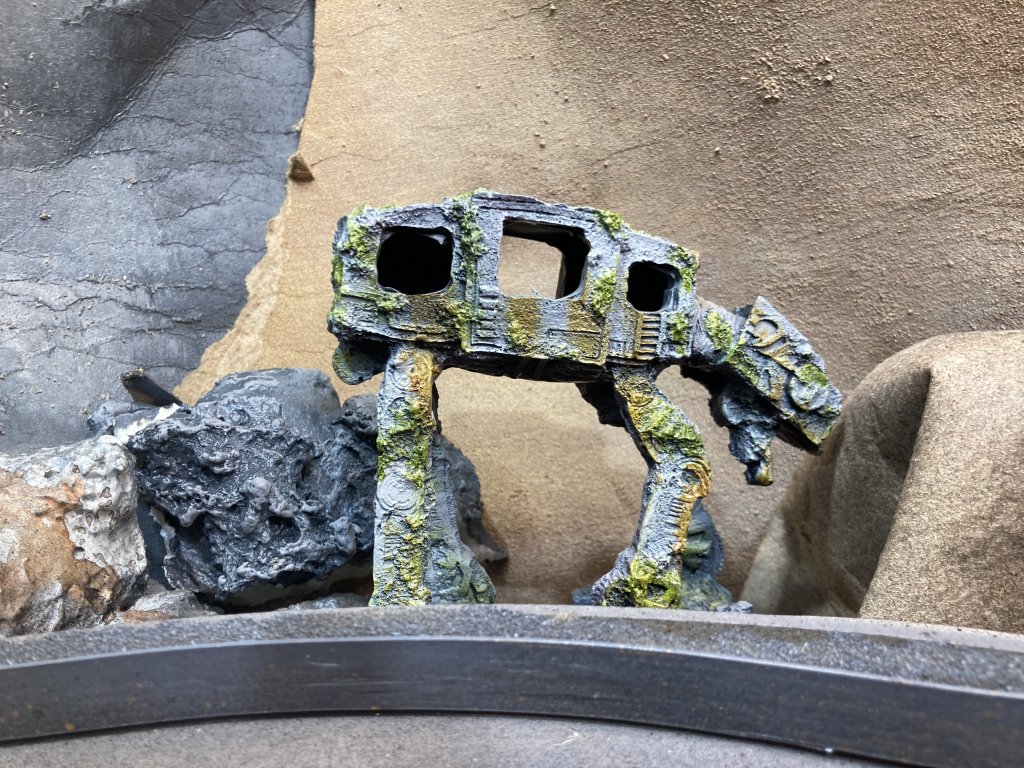
CC: In most of my tracks there are small Easter eggs around the place, whether it’s a funny sign (like the falling rocks sign with a body under a rock next to it at the first diorama canyon track), or hidden items like old competitors' vehicles or Star Wars figures around the place.
There are several items people will likely never ever get to see but I still put them there mostly for me. In the drag track intros at the gas station, there was so much detail inside it and people never got to see it.
There were ads for Pete’s Farm Chips with flavours like “Dirt”. I just find that sort of stuff hilarious so keep including it even if no one gets to see it.
RLD: I know for a fact that your tracks inspire many others to make their own and try their hand at the hobby. What would you suggest/recommend to those looking to build their first track?
CC: I think the biggest thing you need to do before you even start getting your track pieces out is decide what you want to do it for.
Is it just so you have a fun place to race for you, your kids or your friends etc.? Then build whatever you want, as long as you like it.
If you want to build a track because you want to make videos, then you need to think a lot more carefully about how you can film it, what will be blocking the camera, can you move fast enough to keep up with the cars etc.
In the very first lockdown track I built, it had that big jump and I wanted to get a camera at track level to catch the action, so I built a large building that sat on the infield of the corner after the jump and it completely blocked a large part of the corner where all the action was happening.
I also hand build (or now 3D print some pieces) my tracks mostly because what I want to do shape-wise often doesn’t work with standard pieces. However, I will usually use normal track to test fall angles and lengths etc., as it is much faster and easier to adjust.
If you are making a Crash Racer-style track, it’s a bit easier but I don’t like their corners. Slow cars tend to fall over, so getting a corner from someone like Slanman or Spool Heads will give you a much better result and you can still use the Crash Racer straights.

Keeping things fair and fun
RLD: The Chaos Canyon tracks have been road courses with a little bit of everything — lanes, open track, jumps, etc. - which means it's not just about speed. How do you balance fairness with entertainment?
CC: I have a drag track as well, and I find that massively exciting and fun to race by myself or with a friend, but for making videos (particularly the way I was trying to do it with story) it takes just as long to make but each race is 10x shorter, so you end up doing more work for less product.
Also there is less time for any back and forth racing. I love open track because of the unpredictability.
A fast car can be out front with no-one in sight and take a corner too fast and crash out, or you can get multiple overtakes. There have been so many races where you’d swear there was actually someone driving the way a car will randomly swerve around a slower car, or you get great battles and paint swapping, which makes it feel more real to me.
I try to make sure that by the time the cars reach the open track, if they were all as fast as each other, that they should arrive at approximately the same time, or if one is slower, that lane has a higher drop to give it a boost of speed to catch up - like what happens at the Gorge out of the first turn.
It's basically endless testing, testing and some more testing. Then when you think you’re ready, you test some more.
RLD: Given all that testing, I'm sure Gasoline Gorge is certain to run fair and fun. So what are some key traits you feel cars need to be successful — nay, survive — on this track (besides luck)?
CC: With this track I have tried to make it work for anything you want to throw at it. I’ve tested the lifted trucks, food trucks, semi-trucks, low cars, high cars, basically a sample of everything in my extensive collection.
To be successful, lower center-of-gravity is always the best way to go. Plus go with no sharp edges at the front because you hit the walls in the corners and a sharp edge can stop your car in its track, so slightly rounded is good.
Longer wheelbase is also a good idea, as with most open tracks, short wheelbase vehicles usually just spin out all the time.
The good news is you can take a small car, like a CRX and make a custom extended chassis for it, if you really want the body style, because that is part of the wasteland, cobbling together whatever you can to make a car.
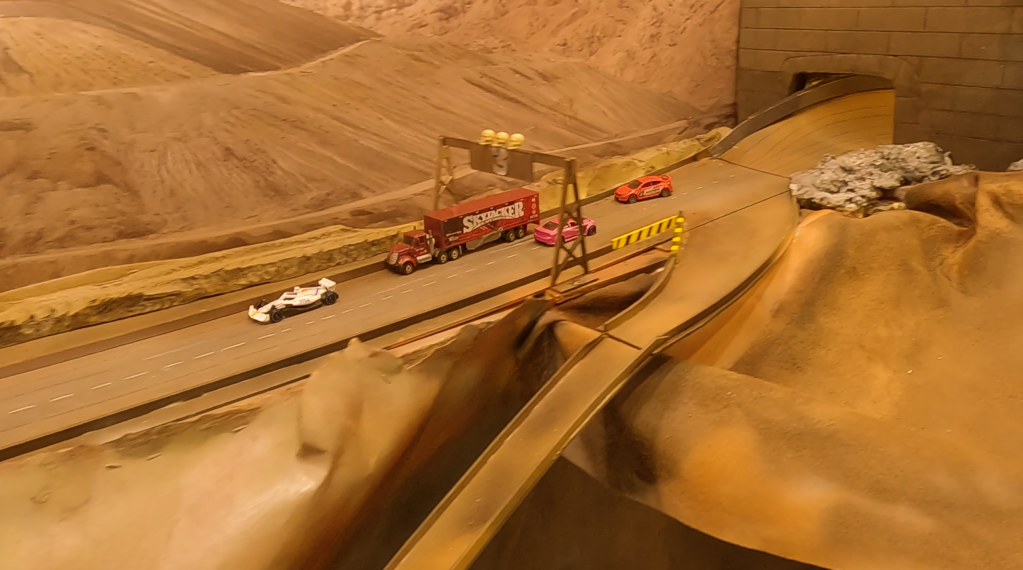
While this series isn’t all about speed, you still want to have a decently fast vehicle or you could stall out in a couple of sections, plus if you decide to take the shortcut lane and don’t clear the jump and land in the toxic pit, your car is immediately dead and out of the competition for good, so speed is still important.
Diecast racing meets tabletop gaming
RLD: Your post on RLD suggested that your race format and scoring on The Gorge is going to be pretty different from prior setups. Can you talk a bit more about what viewers and racers can expect with those changes?
CC: Yeah, this is more about a mix of the Gaslands tabletop game and diecast racing. The rules were even more extensive but it got too hard to be able to track all the various points while filming, so I’ve paired it back, but it is still more complicated than your normal racing.
You will compete in teams of 4 (this can be multiple builders per team or one builder) and there are 4 classes of vehicle you can choose, and you need to think carefully about what you build for the following reasons:
- As well as individual class weight limits, there is an overall team max weight.
- Each class has different Hull Points (HP) that get eroded by things like crashing, or not finishing a race etc., and once you’re out of points that vehicle is out or the season.
- Each class of vehicle also uses a different amount of fuel, and they use that much every race, regardless of whether they finish the race or not, so you need to think about that in your team planning too.
- Don’t have enough fuel to run your remaining vehicles, then you retire from competition until there is a Death Race and you get one chance to redeem yourself and win some much needed fuel.
- You are racing for money (not actual money, just for the race) to buy fuel. There are 5 gates and you get $10 for every gate you pass, then crossing the finish line gets you $50 for first, $30 for second, $20 for third and $10 for fourth. You use your winnings to buy fuel at $50 per barrel.
- So you have to pay attention to the order your vehicles will race in, so as one is eliminated, you know which vehicle replaces it, etc.
The overall rules on the racing/scoring are pretty extensive, so we’ll put up the full rules on the Redline Derby site.
While each class has strict weight guidelines, the actual build rules are pretty loose. Like if you want to smash two cars together to make an extended wheelbase beast, you can. Want to use fantasy castings? You can.
During Death Race matches, there is different scoring and there is a chance that no one will finish a race, but the rewards for each gate and the finish changes to account for it.
In our initial videos, we’ve made a couple of different styles of teams so people will hopefully get an idea of what a good team could look like and what vehicles work well etc. in the context of this new style of racing.

Creating the chaos
RLD: You've built quite a following around the Chaos Canyon brand over the last 6 years or so. Is the channel and community where you hoped it would be by this point, and what's the next big thing you're working toward?
CC: The channel really took off when one of my early Helix rally videos went a bit viral and got close to 800k views. However, it’s been a real slog since then.
I’ve spent thousands of dollars over the last 5 years on cars, equipment, cameras, lighting etc., and the channel doesn’t cover even 1/10th of that.
I had hoped some of the tracks would have done better than the usual 2-4k views I get each race. As an example, the best video I’ve had in the last year was from the stadium rally track I made that had the quarry setting. That video got 10k views and made $48 NZD.
It takes about 4-8 hours per video depending on graphics, camera angles, replays etc., so as an hourly rate, it’s not great. I guess it’s lucky I love making the videos!
I had hoped for more but there must be something that isn’t appealing, at least to the YouTube algorithm, so my videos struggle.
It’s great to see the overall community still growing with more new people coming into it all the time, and Redline Derby has been such a great resource as there is surprisingly little info out there on the hobby other than what you have put together, which is why we’ve always tried to promote the site.
As for the future, I think a lot will depend on how this track goes. If it goes well, I’ll look at making a different version of it most likely. If it doesn’t do well, then I might pull back from making videos and just make dioramas and displays for my cars instead.
I’d still keep a track but it would be for me to play on rather than video, I think.

RLD: A lot of visitors here at RLD are familiar with the Diecast Racing Iceberg and know that a lot more goes into organizing races and producing content than we see in the final videos. What is something about running Chaos Canyon that you didn't realize would be so much work when you started?
CC: Getting commentating balanced is a lot harder than it looks.
Originally I was commentating in a very laid back (Kiwi) way of talking and everyone said it’s too slow/boring, so then I went more over the top and eventually pulled it back to where I am now.
Having "two" commentators helps a lot, as you can have some back and forth, but just having one is absolutely doable, but I find it more restricting.
Trying to also keep the commentating interesting, without constantly repeating the same phrase (I hear that a lot in my earlier videos) and being a cross between real life commentating and a comedy show (which is the style I love) all on the fly and off the cuff can be tough.
I also spend a lot of time rerecording or adjusting dialogue to try and remove pauses, umms, ahhs etc. to let it flow more naturally as a conversation.
RLD: What's been your proudest moment since starting Chaos Canyon and the channel?
CC: I remember the excitement of passing YouTube's criteria to be monetised: 4,000 watch hours and 1,000 subs. That seemed so impossible when I started and it was so exciting to think that many people had subscribed and they’d watched that much of my content.
Then to have my rally video get 800k views was huge.
Gasoline Gorge grand opening
RLD: Back to Gasoline Gorge real quick... I know you haven't even debuted it yet but how are you planning for its evolution over the next year or so?
CC: As with all my tracks, there isn’t necessarily any expansion of the track itself, but there may be different tournaments that evolve over time and there may be more/new traps added to the track over time, depending on how it’s received.
RLD: Do you have a date for when Gasoline Gorge will be open for business? We all want to mark our calendar so we don't miss it! Will it be pick'em races to start and then do some mail-ins later?
CC: With the more complicated scoring and with the potential damage to vehicles (primarily from the swinging weight), I want people to know what they are getting themselves in for before I ask for mail-ins.
Also, as with all our tournaments, any vehicles sent are not returned, and I know that sending four vehicles could be too much for one person to build, which is why we’re allowing multiple builders per team.
I’m hoping to have the first race up around August 15th and that tournament is planned for around a month at this stage.
RLD: And once it's finally open, what are you most excited for people to experience on Gasoline Gorge — either as a viewer or as an entrant?
CC: I think the carnage will be exciting to watch both as an entrant and a viewer. In testing there has been some great racing - like in the intro video, where you see the semi-truck go from last place and bully its way to the front for the neck-and-neck win.
RLD: Before we wrap up... you've been doing this for several years now, and I'm sure Chaos Canyon has grown into something considerably bigger than the hobby you started with. Do you feel like it's shifted from "hobby" to "job" at this point? What keeps you motivated to keep it running?
CC: At this stage I love building cars and making the diorama parts, and designing new tracks is exciting.
It definitely has elements of a job when you have to get a race out each week and the associated work that goes into it, and sometimes with a real job as well it can get a bit overwhelming, but I get excited when I’m editing good racing and I often rewatch my races cause I genuinely find them entertaining.
RLD: How about a few rapid-fire questions...
- Favorite Hot Wheels casting? The ’69 Charger. Not because it’s a good casting, I just love that body shape so much.
- Most memorable race you've ever hosted? I love the Outlaws series. There has been some amazing builds and some great racing across all the tracks.
- Favorite feature or scenery from any of your tracks? The Busters Donut Shop — from the backlit sign to the rotating donut to the detail inside the building, I just love it.
- Coffee or energy drinks during all-night build sessions? Live+ energy drinks all the way.
- One tool you couldn't build without? A good knife for track building, and the right drill bits for building cars.
- One word that describes Gasoline Gorge? Savage.
RLD: Lastly, is there anything else you'd like to share or shoutout about your journey through the hobby so far?
CC: A massive shout out to the people that signed up to be a channel member first of all. They have kept me going when my video views are low and I’ve loved sharing all the build progress on all my tracks with them.
The triumphs and the tragedies, the successes and the failures. Hopefully they’ve enjoyed watching behind the curtain.
Shoutout to Redline Derby, such an amazing resource for us all and a great place to get help, advice and find out about events etc.
Specific shout out to Enzed Racing. Great guy that I interact with a lot and who has come round to the canyon a couple of times to race and share knowledge etc.
Thank you, Chaos Canyon!
Again, I want to thank Warwick for spending the time to chat about the new Gasoline Gorge and Chaos Canyon at large. The hype video for Gasoline Gorge makes this track appointment viewing once things go live this month. Make sure you follow him on YouTube and consider being a paid subscriber if you like the entertainment he offers.
- Original post about Gasoline Gorge, with more photos!
- Behind-the-scenes video of Chaos Canyon (from 2021)
- Chaos Canyon channel on YouTube, watch and subscribe!
- Visit the official website for merch and more
Chaos Canyon has been a big supporter of Redline Derby Racing over the last 5 years and I appreciate everything he's shared on the site to help inspire racers from around the world.
Discussion

I have enjoyed watching so many Chaos Canyon videos over the years. I am looking forward to Gasoline Gorge! Thank you for all of the entertainment over the years.
great interview!
and to Chaos, thanks for all you have done!
dr

A great interview.
More like this please!
Again a big thank you to all out there who host tournaments and produce great content for us all to watch on their YouTube channels.
A lot of time, cost and effort that goes into making videos that then entertains us all.
Thanks

Amazing interview! Love all your tracks and have had the pleasure of racing on them my self. Keep up the good work!
- Thanks and we hope to see you out on the new track at some point too — Chaos_Canyon
- Work and home been crazy lately, but I will do my best! — JBlotner42

I'll All In For Something Like a Demolition Derby, & What 2D Likes, Fatalities...! So I'll See If Budgets are Good for a Shipping to New Zealand

Great interview! Can't wait to see the carnage from this track and hopefully get a run at it. Heck would love to run at any of your tracks. Chaos keep up the awesome stuff man. We all enjoy it.
- Just released the first race now so make sure to check out the chaos — Chaos_Canyon
- I know what I am doing this evening! — Partsman73

Bro!!! Thank you for the mention xoxo
From a spectators point of view, I'd like to mention to everyone on how much work has gone into these tracks. Its quite an experience to have a look Behind The Scenes, not only as a channel Member but also in real life.
Gasoline Gorge is probably the most aggressive track I've ever seen and definitely requires a strong build to even finish.
Good luck to all future builders
Love this interview Brian! And love that RLD even does these. Most folks might assume I found 3D to be the inspiration for LYDC but believe it or not, it was finding Chaos Canyon that actually got me building something to race on.
Wishing CC continued success as one of the best venues out there.
- Thank you so much! I really appreciate that. I've really enjoyed your tracks too and we look forward to hosting more tournaments — Chaos_Canyon
Thanks again Brian. This site has been so amazing on this diecast journey, I'm happy to give back wherever I can,